
Karan Babbar and Raunak Maitra
Out of the 164 countries for which estimates are available, India is one of only five to raise basic drinking water in schools by more than four percentage points a year. When the government launched the Swachh Bharat Mission in 2014, its school initiative committed to providing separate toilets for boys and girls in all government schools. Twelve years on, the WHO/UNICEF Joint Monitoring Programme’s estimates for 2026 indicate that access to basic sanitation in Indian schools increased from 62% in 2015 to 81% in 2025, with access to basic drinking water rising from 55% to 97%, which is one of the most rapid improvements among the 164 countries for which data is available. According to India’s own school census, UDISE+ 2025-26, 98.5% of schools for girls and co-educational schools, which admit and educate both boys and girls in the same classrooms, now have a toilet for girls..
It is a great achievement, but it also brings up the next challenge, one that many countries will soon have to deal with: a toilet which exists is not the same as a toilet which works. Climate change is likely to widen this gap. A toilet only works if it has a reliable water supply and can withstand local conditions, and as rainfall becomes more erratic, keeping school toilets working gets harder, especially in already vulnerable regions.
The functionality gap
The UDISE+ system applies strict criteria when it comes to what constitutes a functional toilet: it must have a supply of water, have unbroken seats, have working drainage, be cleaned regularly, have only a minimal odour, be accessible to users and have doors that close. Under this definition, 38,994 Indian schools have a girls’ toilet which is not currently working and an additional 22,366 schools have no girls’ toilet at all. Taken together, this means that there are more than 61,000 schools in which girls cannot count on having a working toilet.
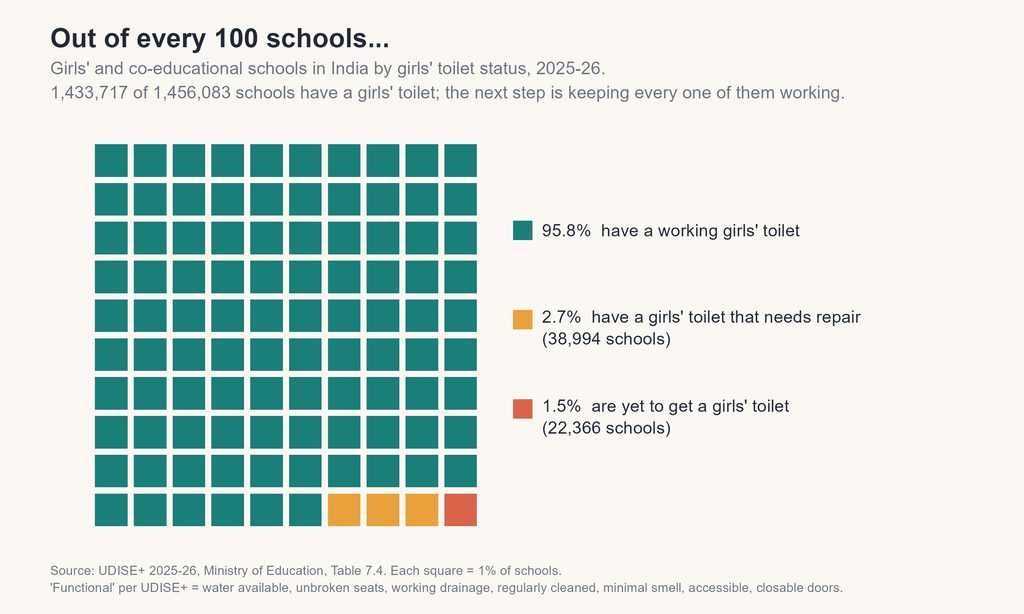
Figure 1: Out of every 100 schools in India. Girls’ and co-educational schools by status of the girls’ toilet, 2025–26. Each square represents 1% of schools. Source: UDISE+ 2025–26, Ministry of Education, Government of India (Table 7.4).
This is important, as school toilets should be considered part of educational infrastructure just as much as they are of health infrastructure. Anjali Adukia’s study of India’s school latrine programme showed that the construction of toilets led to a substantial increase in the enrolment of adolescent girls, mainly in cases where separate toilets for girls were available. At puberty, issues of privacy, safety and the ability to manage menstruation become decisive in determining whether or not a girl remains in school. A faulty toilet thus quietly reverses this improvement.
Where climate meets sanitation
The gap in terms of functionality is not uniform. In 24 of the 36 states and union territories of India at least 95 per cent of schools have a working girls’ toilet. The figure is much lower in the hill states of north-eastern India: 72.4 per cent in Meghalaya, 74.4 per cent in Arunachal Pradesh and 74.7 per cent in Tripura.
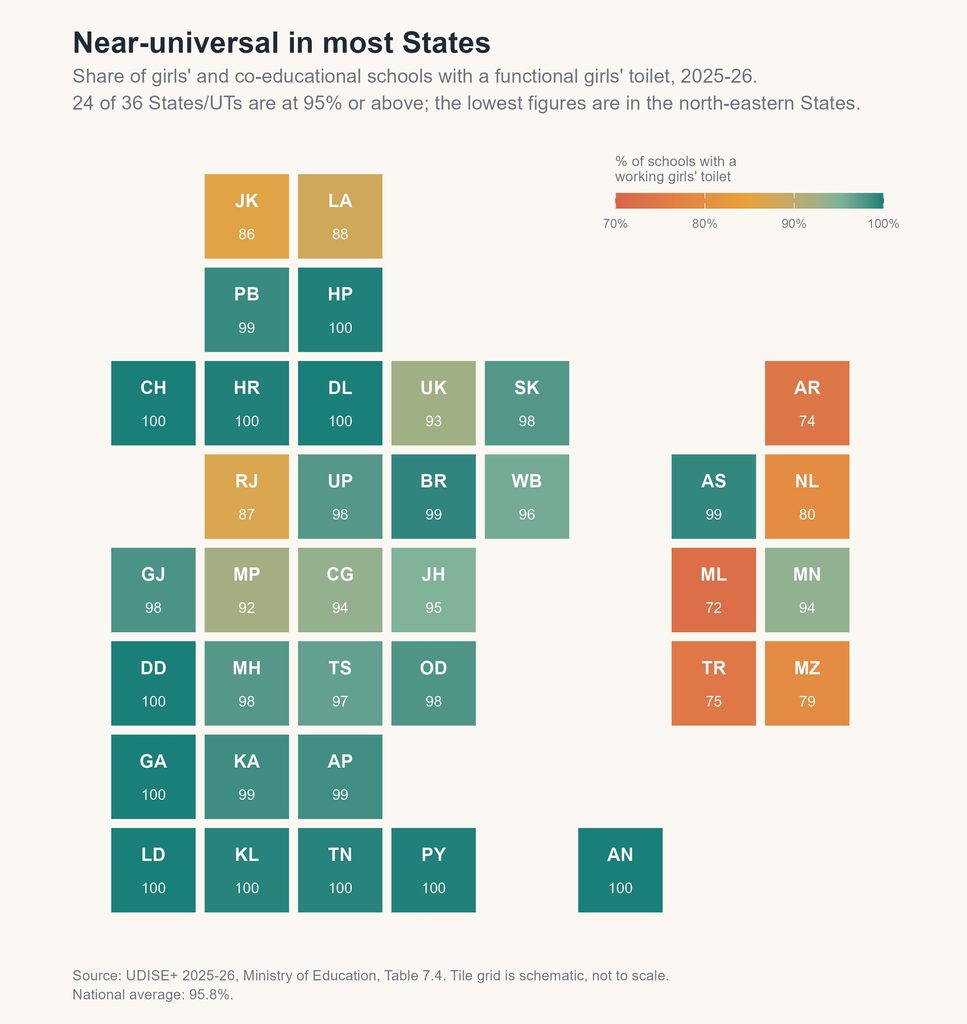
Figure 2: Near-universal in most States, lowest in the north-east. Share of girls’ and co-educational schools with a functional girls’ toilet, by State and Union Territory, 2025–26. The tile grid is schematic, not to scale. Source: UDISE+ 2025–26, Ministry of Education, Government of India (Table 7.4).
Meghalaya is one of the wettest places on Earth, but in many of its schools it is difficult to keep water in the toilets. Most of the rain falls in the monsoon months, and in the dry season springs and streams run low. In Sohra (Cherrapunji), long known as one of the wettest places on record, residents say they have to buy water through the winter, sometimes paying nearly ₹1,000 for 500 litres. Schools face the same problem. When Biome Environmental Trust worked with schools in Meghalaya, it found that many toilets built under the Swachh Vidyalaya Abhiyan did not work because there was no water for them. Its response, starting with a pilot at Umthli Lower Primary School in East Khasi Hills, was to install rooftop rainwater harvesting. The area’s steep landscape, its widely scattered villages and the fact that water is sometimes in short supply seasonally all make it hard to supply and repair the facilities, and these difficulties may grow: Meghalaya recorded India’s highest rainfall deficit in the 2026 monsoon, 59% below normal, continuing a decline in monsoon rainfall that the IMD found over 1989–2018. A toilet that has no water does not meet the basic requirement of being functional and once it becomes unusable, cleaning and repairs often lapse.
The takeaway with regard to climate-resilient sanitation is that additional construction will not eliminate this gap; instead, what is effective is a design appropriate to local conditions, such as linking rainwater harvesting directly to school toilets, using low-water toilet designs, employing durable materials capable of enduring heavy rain and humidity, and ensuring that maintenance budgets keep up with the severe conditions.
Inclusion: who is left out when toilets fail
The consequences of a school toilet breakdown are felt most by girls. According to the Indian National Family Health Survey (NFHS-6, 2023–24), 75% of rural young women between the ages of 15 and 24 use hygienic menstrual protection, whereas 90.7% of their urban counterparts do. For a rural adolescent girl, a toilet which has water, a waste disposal facility and access to sanitary pads can make a difference to whether or not she goes to school during her period. Children with disabilities are in a similar situation since a deteriorated accessible toilet completely excludes them.
UDISE+ currently obtains information from schools regarding incinerators, sanitary pad vending machines, and disability-friendly toilets; if this information is properly utilised it could be used to direct support to the schools where girls and children with disabilities are most at risk of being left behind.
Who verifies the numbers?
There is also a problem relating to measurement. While UDISE+ states that 97 per cent of schools in India have at least one working toilet, the JMP gives the figure for basic sanitation as 81 per cent. The difference is even greater when it comes to hygiene: UDISE+ says that handwashing facilities are available in 96.9 per cent of schools, whereas the JMP estimates basic hygiene, that is, both soap and water being available, at about 53 per cent. The figures from UDISE+ are provided by the head teachers themselves and are certified by the same administration that runs the schools. Any nation that depends on administrative data to track its progress on the Sustainable Development Goals has to deal with this issue. That includes the target for safe, inclusive school facilities with water, separate toilets and handwashing (SDG 4.a), and the targets for safe drinking water (SDG 6.1) and sanitation and hygiene for all (SDG 6.2). Independent spot checks, or monthly audits carried out by parents and school committees using the same functionality checklist, would make the numbers more reliable.
From coverage to everyday functionality
The example of India demonstrates that it is possible to achieve widespread toilet coverage within ten years. Moreover, India’s experience indicates that coverage alone is not enough; equal opportunities for all children depend on toilets that function every day throughout the year. This in turn calls for dedicated funding for maintenance, for design that takes account of the climate in vulnerable areas, for menstrual health to be at the heart of school sanitation measures, and for data that can be independently verified. We set out in more detail the way forward for India in The Hindu.
Raunak Maitra is an Academic Associate at Azim Premji University, Bhopal and Karan Babbar is an Assistant Professor at XLRI Xavier School of Management, Jamshedpur.
Comments are closed