
By Amita Bhakta
This blog was originally published for the Modern Energy Cooking Services programme at Loughborough University and is available here.
This blog is part of a series documenting the nuanced learnings from Phase II of the Accessible Energy study for People with Disabilities initiative, implemented in Ahmedabad with 18 women with varied disabilities. The series explores the multiple factors that influence their transition from traditional cooking methods to e-cooking appliances.
Cooking diaries, an approach to understanding daily eCooking patterns and energy usage has been long established by the MECS programme. In our research on inclusive eCooking for people with disabilities (PwDs) in Ahmedabad, India, Prabhat Education Foundation and I sought to understand how accessible and suitable eCooking appliances such as electric pressure cookers (EPCs), rice cookers, and induction cookers were for differently abled people. As we set out on this research, we had a range of questions in mind. What are PwDs and caregivers cooking with eCooking appliances? How can you use an EPC or an induction to cook if you cannot see? When you can’t hear, what do eCooking appliances need to be able to do to tell you that your food is ready? And overall, how can we better include people with disabilities in the future design of eCooking technologies? To answer these questions, we needed creative and innovative approaches, designed in collaboration with PwDs who sometimes need tools to be a little different for them, and their caregivers.
A journey of trial and error towards inclusive and effective eCooking diaries
As we set out on our cooking diaries journey, the process was new to the whole team. A co-design workshop in November 2025 with the research participants indicated that they liked a traditional pen and paper method. But, when we tried a series of questions on a sheet of paper which had only two to three options for determining things like when cooking was being done, or the time taken for something to cook, it was not giving us much of a story behind the accessibility of the appliances and how participants made eCooking work.
At the same time, something deeply engaging had emerged organically between the team and the participants. As soon as PwDs and caregivers had their eCooking appliances installed, they began to experiment with different local dishes such as dal, bataka nu shak (potato curry), bhinda nu shak (okra), rengan nu shak (aubergine), khichdi, pulao rice, and many more, using EPCs, rice cookers and induction cookers. In the excitement of experimenting with these new technologies that had found a place in their home, PwDs and caregivers started to send videos of themselves cooking with eCooking technologies to a WhatsApp group with the research team (Figure 1). As we learned, the participants were very proactive in making videos, and so we followed up with them on how we can improve the cooking diaries.
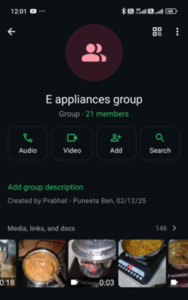
The eCooking and disability appliances WhatsApp group with PwDs and caregivers that inspired the cooking diaries (Photo: Prabhat Education Foundation)
Implementing eCooking diaries with PwDs and caregivers
Through our cooking diaries process, we wanted to find out answers to specific questions. What did participants cook today, and how many people were they cooking for with the eCooking appliances? How did they feel as they used the eCooking appliances? Which features did they use to cook the dishes, and why? Which features of the appliance were they finding more difficult because of their disability, and why? Did the dishes they were cooking taste the same? Through these questions, we wanted to collectively capture their overall culinary experiences with eCooking appliances. By using the dishes that they were making as an entry point, we could then create a dialogue about what it was about the appliances that made the process easier for them in terms of their needs. For the differently abled participants, we were interested in understanding more about existing design and accessibility, whilst for caregivers, we wondered what impact eCooking appliances could have on their daily routines and whether any time saved supported their caregiving for PwDs.
We knew that the cooking diaries would need to be tailored to the needs of each individual, based on how they could most comfortably communicate their stories with us. We spoke with our participants regarding their preferences, and we co-designed three formats of diaries: telediaries, audio diaries, and video diaries, which were kept for ten days.
‘Telediaries’ were telephone diaries. Through the telediaries process, the team phoned participants every two days, and asked them to reflect on the questions based on their cooking experiences during that time, recorded the chat, and then transcribed it. Telediaries were found to be very useful particularly for people who were visually impaired, or were unable to access or physically hold a mobile phone to record themselves, because it was conducted through a simple phone call. Participants who were more familiar with technology were encouraged to record video and audio reflections using their smartphones. As the diaries gathered pace, the team’s WhatsApp chats were filled with granular, in-depth, visual stories of people with different impairments and their caregivers trying to make dishes from dal to dhokla, using trial and error to find the right functions for their dishes.
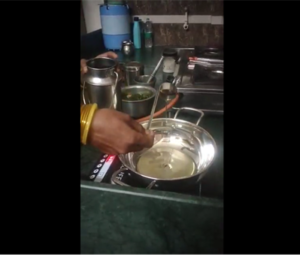
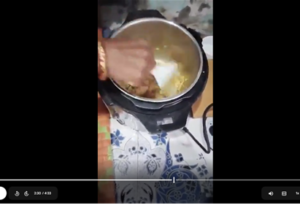
Figure 2-3: Screen shots from video diaries recorded by participants (Photos: (1) © Kalaben Vaid (2) © Geeta Patel)
By focusing on the dishes that were cooked and using these as a talking point, we were able to delve deeper into the benefits of eCooking for PwDs and their caregivers. Understanding how an okra curry was made through making conversation via telediary with a step-by-step process enabled participants to tell a story around what happened as they prepared the dish, how they found the features helpful or challenging, and any frustrations they had faced. Capturing these experiences as they happened gave us an opportunity to capture specific details on how eCooking appliances can be adapted to the specific needs of PwDs and their caregivers’, be it through audio features, braille labels, or lights.
The way forward
Including people with disabilities presents an opportunity to improve technology design for EPCs, induction cookers, rice cookers and more. As we make the transition to eCooking, this study has enabled us to explore how we can use cooking diaries to best capture the realities of cooks with disabilities, in a way that works for diverse bodies, needs, and everyday routines.
Comments are closed